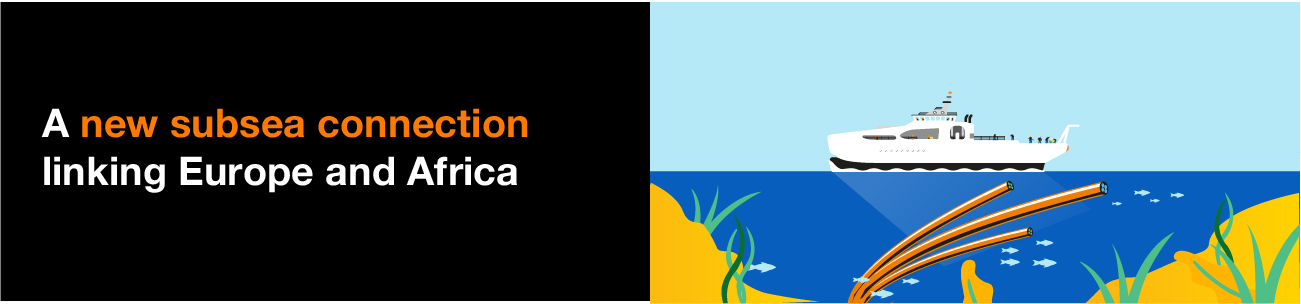
A memorandum of understanding was signed by Orange and other major carriers to form a consortium and kick-start the ambitious submarine cable system project that will deliver much-needed redundancy to the whole west African coast, further helping bridge the digital divide on the continent.
A new submarine cable project expanding connectivity all along the western coast of Africa

Due for completion in 2030, Via Africa may connect some 20 African countries along the Atlantic coast, from the United Kingdom to South Africa. Under the currently proposed design, France, Portugal, the Canary Islands, Mauritania, Senegal, Guinea, Côte d’Ivoire and Nigeria will be connected to the new subsea cable system, securing and strengthening economic development, partnerships within Africa and with Europe.
A consortium of European and African carriers to steer the project
The Via Africa project is managed by a consortium of stakeholders led by such European and African carriers as:
- Axian Telecom/Silverlinks,
- Canalink,
- Guilab,
- International Mauritania Telecom,
- and three entities of the Orange Group – Orange SA, Sonatel and Orange Ivory Coast
This consortium remains open to new investors willing to adhere to the “open access” cable model.
A new route to secure resilient connectivity and bridge the digital divide
Given the aging of certain undersea infrastructure—notably ACE, which is expected to reach the end of its service life by 2030—and the natural risks to which it is exposed, Via Africa will enhance the resilience and security of the continent’s connectivity, complementing the Djoliba terrestrial network to provide integrated land-sea coverage. While the new route has yet to be surveyed and mapped, avoiding known single points of failure will be a key concern.
By supporting this new subsea cable project, Orange reaffirms its commitment to “give everyone the keys to a responsible digital world”, and to help drive the growth of connectivity in Africa, alongside the Orange Group’s 18 subsidiaries serving 145 million customers in the MEA region.
How does resilient subsea connectivity help drive the growth of connectivity in Africa?
New subsea cables and new submarine routes mean new opportunities in Africa, especially with open access cables. Increasing the diversity of subsea connectivity options also helps avoid black outs when single points of failures cause cable outages along busy routes.
How does subsea connectivity drive economic growth in Africa?
Resilient subsea connectivity is a key driver for unlocking Africa’s economic potential. Reliable high-speed internet access enables digital transformation across sectors, from e-commerce and financial services to education and healthcare. The 2Africa network, commissioned at the end of 2025 and connecting 33 African countries (with Orange being part of the consortium), contributes to digital economic activity, attracts foreign investments and stimulates the growth of local technology ecosystems. According to RTI International, this network could increase Africa's GDP by nearly 0.58%.
What is an open-access cable and why does it matter for Africa?
Open-access subsea cables allow multiple operators and service providers to purchase capacity on equal terms, rather than being owned exclusively by a single consortium. This model prevents monopolistic control and ensures fair access to capacity, lowers the cost of internet services for consumers and businesses, enables smaller operators to compete, and accelerates digital inclusion across underserved regions. For instance, operators of every landing station on the 2Africa cable, commissioned in late 2025, must provide access to international capacity at fair and reasonable prices, and on transparent and non-discriminatory terms.
Which subsea cable systems currently connect Africa to the world?
Africa’s subsea cable landscape has expanded significantly, with over 23 cables connecting the continent to Europe, the Middle East, and beyond. Major systems include SAT-3, WACS (West Africa Cable System), ACE (Africa Coast to Europe), MainOne and 2Africa which collectively serve millions across coastal and inland regions.
How does subsea cable redundancy help secure Africa’s economic development?
Much of these cable systems suffer from two weaknesses: ageing technology restricting available bandwidth and concentration along submarine routes prone to suffer natural hazards. In March 2024, four cables—WACS, ACE, MainOne, and SAT-3—were simultaneously severed off Ivory Coast in the "Trou sans fond" canyon at 3,000 meters depth, 950Gb/s of capacity was lost, disrupting connectivity across 12 countries. Traffic was restored by rerouting it through Orange’s Djoliba terrestrial network in West Africa while awaiting the arrival of Orange Marine, which carried out repairs in record time at a depth of nearly 6,000 metres. This event underscored the urgent need for alternative routes and diversified landing points to ensure continuous connectivity, essential for protecting economic investments.